


 Posts


I scribbled down the words “The Church is not a memorial society to a dead Jesus.” Patricia was teaching Sunday school on Acts, the part of the Bible where Christianity begins to take shape, where decisions are made about who’s in and who’s out. So if we don’t go to church to mumble, murmur and be reverent, it probably means we come for community and to figure out just what it is we should be doing in this life. God’s work, Her will, His love. Charged by the Holy Spirit perhaps, that strange wind that whips around and through and beyond.
Tell the truth. That’s a good one. Don’t cut in line. Don’t cut corners where they should not be cut. Practice tolerance with people who irritate you, try to keep your mouth shut. Don’t be impolite. Enjoy your fellow man. Talk to the person behind you in line at the WalMart. Be genuinely interested when she tells you she used to sew costumes for the Atlanta Ballet and now her 50-year-old son has moved back home. Listen with all your heart as this person passes on a few personal worries, and chooses to tell her story to you, a stranger. Dig deep down in your purse or in your wallet when you’re on your way home from the airport late at night on the MARTA train. See the old woman with the placard sign that shows news events for the past 20 years that prove the end of the world is nigh. Press a $20 in her hand and be sorry that you can’t give her more because you know without a doubt she could be your grandmother.
I think those are all very nice things to do. I think most of us pretty much try to do the small, easy stuff. What I’ve found more difficult, however, is doing what Jesus really did well, that is going out and getting your hands dirty. Even if it means looking at something we’d rather not. I’d rather not. So lately I find myself on this Diocesan task force to stop sex trafficking of children in Atlanta. Me squeamish in that I had to leave “Silence of the Lambs” half way through. The evil, though just a movie, was too easy to feel, too disturbing, too potentially real.
My job on the task force will be to write whatever is needed. How I thought I’d pull that off blind folded I’m not quite certain. Most people on the committee are doing important work to fight the kidnapping and selling of children from five to 18 for rape, abuse and torture.
One committee member in that first meeting said you could see children being prostituted downtown every day. For instance, if you see a 14-year-old girl with a $10 bill sticking out of her shirt, it’s like a price tag. I won’t say for what, but you get the picture. I told him the thought of it just made me want to die.
Anyway, all of us on the committee were invited, no urged to attend the screening of a movie about the problem at the Rialto at Georgia State. I got my dates wrong at first and thought the movie was a week ago, Sunday. On that day, I went to church, but I dreaded going to the movie. I just couldn’t see what good it would do for me to see any of this going on really vividly like in the “Silence of the Lambs” sense. In fact, as the 5 p.m. show time neared, I actually found a plausible excuse to miss the movie altogether, one that I almost believed myself.
Well, it turned out that Sunday a week ago was the wrong day. The documentary, Playground, was playing yesterday. And I did not want to go then either. But thinking about doing, really doing, I got up my courage and went. And for the full 80 minutes, I sat and watched and listened to the saddest, most frightening and disturbing stories I really think anyone will ever hear. These are children. They come from every socio economic background. They are so damaged that anyone would say they can’t be brought back. Better to forget and throw them away.
But this isn’t what these priests and volunteers and cops and judges and activists and students do. They fight something that frankly nobody wants to hear, an image nobody wants to fall asleep with or wake up to. I certainly don’t. But I think it’s a bit like the engineer on our committee said: “You can’t know about it and not try to do something about it.” And this engineer had come to the subject simply by entering the wrong room at the Diocesan Council.
I came to it that way a little myself, sitting in on that meeting in a sort of random way. But more, I was lamenting to Patricia that frankly I was useless to really help people. I have no skills that will mend broken bodies or broken souls, no money to build shelters, not even handy in the kitchen for that matter. But she encouraged me and said my modest skills could be put to work. In fact, she said, that task force on the sex trafficking of children, she thought needed a writer. But now I’m not sure getting your hands dirty is even about possessing specific skills. I think it may be first and foremost about not turning away.
Monday, May 3, 2010


Monday, April 26, 2010
The Sheep of Iona
I hadn’t been to the early service for at least a month what with all of the Holy Week activities and then the annual Parish meeting last week. So I set my alarm for 6:30 a.m. last night, plenty of time to compensate for any bad rolling over type behavior. As I pulled into the parking lot, I noticed the absence of Patricia’s red station wagon, with the bumper sticker that says “Separate Church & Hate.” In a space nearby, I saw a blue sedan—and remembered that Patricia was in San Francisco at her 30-year Peace Corp reunion.
I headed for the door, just in time to unlock it for Tim, whose arms were loaded down with projector-computer-type Sunday School teacher stuff. “You preaching, too?” I asked. He was not, just teaching.
Inside the door Maggie greeted me. “You preaching?” I asked for the second time in as many minutes. I think she nodded her head. In fact, I’m not sure what she said, if it was “good morning” or “yes I prepared a sermon” or what. But Maggie’s smile – indeed her whole mood -- was immediately infectious. I found myself smiling as I made a pot of coffee, for no good reason. It was like one of those song lyrics that you hear and then you can’t get out of your head.
 In her sermon she talked about a long-ago pilgrimage that she made to the Isle of Iona, one of the oldest landmarks of Christianity. She recounted how a monastery had been founded there in 563 by Saint Columba and how the tiny island became the burial place for Scottish kings. How the island and Abbey became a holy place of pilgrimage.
Maggie also d escribed the green rolling pasture land that surrounded the ancient edifice, and said one evening she and her companions sat outside watching the sheep that dot the landscape. As the day drew to a close, the mother sheep began
 calling their babies. A pair of twins, she’d been watching, heard their mother’s call amidst the general commotion of bleeting and bahhing of the other mothers. She watched as the twins immediately went to and found their mother and noted that all of the other babies were paired correctly with their mothers as they all settled down for the night.
The story helped to reshape and deepen the Gospel reading, John 10:22-30. Temple officials are trying to get Jesus to say he’s the Messiah but he has no plans to. “My sheep hear my voice,” he says. “I know them and they follow me.”
There are voices in our heads that we hear, all kinds of voices. Sometimes it’s the voice of denial and sometimes it’s the voice of God, Maggie said.
So I’ve been pondering the voices in my head quite a bit today. Sometimes, I find, I have more than one voice coming at me on the same subject. Neither is completely wrong but neither is completely right either. I’ll have to keep working on that one.
As far as the voice of God, I’m not really sure he comes to me that way, or that I think of her in that way. Although, of course, that makes perfect sense. But I can feel God, I think, in others. Just as it’s hard to see pain and grief in a friend without getting a knot in your stomach, there is also that pure unconscious joy that spreads from one person to another, spreads from the outside in,turned out again, almost light enough to be carried away by the wind. The gifts of God for the people of God.
I headed for the door, just in time to unlock it for Tim, whose arms were loaded down with projector-computer-type Sunday School teacher stuff. “You preaching, too?” I asked. He was not, just teaching.
Inside the door Maggie greeted me. “You preaching?” I asked for the second time in as many minutes. I think she nodded her head. In fact, I’m not sure what she said, if it was “good morning” or “yes I prepared a sermon” or what. But Maggie’s smile – indeed her whole mood -- was immediately infectious. I found myself smiling as I made a pot of coffee, for no good reason. It was like one of those song lyrics that you hear and then you can’t get out of your head.
 In her sermon she talked about a long-ago pilgrimage that she made to the Isle of Iona, one of the oldest landmarks of Christianity. She recounted how a monastery had been founded there in 563 by Saint Columba and how the tiny island became the burial place for Scottish kings. How the island and Abbey became a holy place of pilgrimage.
Maggie also d
 escribed the green rolling pasture land that surrounded the ancient edifice, and said one evening she and her companions sat outside watching the sheep that dot the landscape. As the day drew to a close, the mother sheep began
 calling their babies. A pair of twins, she’d been watching, heard their mother’s call amidst the general commotion of bleeting and bahhing of the other mothers. She watched as the twins immediately went to and found their mother and noted that all of the other babies were paired correctly with their mothers as they all settled down for the night.
The story helped to reshape and deepen the Gospel reading, John 10:22-30. Temple officials are trying to get Jesus to say he’s the Messiah but he has no plans to. “My sheep hear my voice,” he says. “I know them and they follow me.”
There are voices in our heads that we hear, all kinds of voices. Sometimes it’s the voice of denial and sometimes it’s the voice of God, Maggie said.
So I’ve been pondering the voices in my head quite a bit today. Sometimes, I find, I have more than one voice coming at me on the same subject. Neither is completely wrong but neither is completely right either. I’ll have to keep working on that one.
As far as the voice of God, I’m not really sure he comes to me that way, or that I think of her in that way. Although, of course, that makes perfect sense. But I can feel God, I think, in others. Just as it’s hard to see pain and grief in a friend without getting a knot in your stomach, there is also that pure unconscious joy that spreads from one person to another, spreads from the outside in,turned out again, almost light enough to be carried away by the wind. The gifts of God for the people of God.
Sunday, April 18, 2010
Breakfast with Jesus on the Beach
I was sitting in my regular pew with Nancy Dillion in the row in front of me and Joe Monti in the row behind me. Nancy was just back from vacationing with her family in Hawaii and of course, anyone who’s ever sat in front of Joe knows they can sort of hide their own off-key singing in the shadow of his booming baritone voice.
Tim Black, who I’ve come to think of as St. Dunstan’s own personal seminarian over the last three years, read the Gospel. It was John 21:1-19, about Jesus showing himself to the disciples by the Sea of Tiberias. They were Simon Peter, Thomas, Nathanael, the sons of Zebedee and two unnamed disciples, maybe women—who knows?
Anyway, they were all going fishing. They didn’t catch a thing and then around daybreak, they saw Jesus standing on the beach. After a little back and forth, Jesus, now sitting by a charcoal fire says, “Come and have breakfast.”
Now I know “Come and have breakfast” is certainly not the point of that Gospel reading. But this morning, to me, it was. What rang so clearly was that as the sun was rising, the disciples were starting their day in a pretty good way—having breakfast with Jesus on a beach.
That was not at all how my morning started. I woke up too early and rather than get up and do something useful, I laid in bed and let my mind wonder aimlessly to worrisome topics.
I complained to myself about how I’d actually gotten the house clean and the dog had stained the bed spread I just got for Wolfie for the summer, something quilted but light and made of cotton. How do you get stains out of cotton that isn’t white? Bleach works on white cotton obviously, but the new bed spread is sort of a lighter Master’s green.
So petty worries. Like potato chips, just one on top of the other. Then where was I going to find the right size trays for Vincent’s wedding reception? And as the unsung mother of the groom, why should I be worried about trays anyway?
So rather than get up and face my grumpy self, I rolled over instead. I didn’t have to leave until at least 8:30 because today was the annual Parish meeting, meaning I’d go to the regular service and stay afterwards for potluck. Then I overslept. Didn’t have time to pick up something for the potluck from the grocery store. Grabbed a salad from last night out of the frig, an extra avocado, tomato and some ranch dressing and ran out the door. I did this quickly knowing that I was going to be about 30 minutes late for Sunday School, which was Craig Withers talking about his work in world public health with the Carter Center, something I’ve really been looking forward to. I caught the tail end.
But as I’m sitting there in my pew, that breakfast with Jesus thing continued to resonate, even as Patricia gave this great sermon about the reading that pointed out that the most unlikely people can be good disciples and leaders. The most unlikely people can heed Jesus’ directive to Simon Peter to “Feed my sheep.”
Instead of absorbing the true message, I’m thinking about that old saying that the beginning of the day is a pretty good indication of how the rest of the day is going to play out. It’s supposed to apply to relationships, so if you start out in a rocky relationship, for instance, there’s not a lot of reason to think that it’s going to be any different with time.
So I’m sitting there thinking if I had had a better start to the day, like the disciples did a couple a thousand years ago, having breakfast on the beach with Jesus, I might actually be able to pay attention to the sermon. I bet after they started their day like that, the rest of the day was incredible. I bet they were all glowing. I bet the air smelled fresher and the sand was cool under their feet and the sky looked a little bluer.
After church, we had our potluck. I wasn’t feeling very chatty. I ate three different kinds of chocolate dessert as I listened to the foodies at my table trade cooking and dining tips. Peachy said she liked to eat just about anything that didn’t move, to which Nancy Dillion replied, “What do you think a fork is for?”
We all laughed. But my mind still wandered in a very self-indulgent way. While Patricia gave the report, she brought up the fact that Tim will be leaving us soon because he has just one more week of seminary, then he’ll be getting a job and being a priest full time somewhere. It conjured up images of the times Tim invited and re-invited me to Sunday School, how he’d dug up the liturgy for my mother’s house blessing last Easter.
Someone asked if we’d be getting another seminarian (see I’m not the only one who takes ownership). In my less-than-good spirits, my knee-jerk mental reaction, “Nope, that was a one time deal.”
To my surprise, Patricia told us actually there were two candidates that the school had asked her to consider. Even as Tim is leaving, there’s a great likelihood that another student will come. It is possible that we’ll take pride in a few years as this now unnamed seminarian is ordained at the Cathedral as a Deacon. We might smile seeing a fresh white collar, feeling somehow that we were part of the process that brought our seminarian to this point.
And from there, despite the fact that my day did not start out with Jesus on the beach, my mood began to improve, or rather that fever of general irritation broke. Patricia asked us to look for examples of renewal this year. And since she said that, I’ve had a hard time on that front, not looking, but finding. Would another seminarian count as renewal?
Now I’m in better spirits. It’s almost 5 p.m. on a Sunday afternoon. And I know that every day we have a chance to make a better day, to begin again.
But I’m now firmly against that saying about how your day starts so goes your life. And that applies to days, and habits, and forgiveness and getting along with other people. Because most of us don’t get to start our days having breakfast with Jesus on the beach, we just have to begin where we are and have faith that things will get better.
Sunday, April 11, 2010
Look for Renewal
 The Easter Vigil began outside in the Beech Grove behind the church. Patricia told us this was her favorite service of the year and one of the oldest services in Christianity. Beginning the night before Easter at sundown, we all lit our candles from the Paschal candle. Armed with tiny silver bells, our flickering candles and programs, we followed chants into a darkened sanctuary.

There the altar was shrouded in black cloth.
And then when Lent was over, Patricia and Maggie and Tim stripped the altar of its widows' weeds, revealing light an
 d life and Patricia shouting joyfully "Alleluia! Christ has Risen!" to which we responded "Alleluia! The Lord is Risen Indeed!" And as she repeated these words three times, the sound of little silver bells rang throughout the sanctuary, gaining in volume with the sound of her voice. Alleluia!!
Then, celebrating that new life, we renewed our baptismal vows. Patricia blessed the water, then walked around the sanctuary blessing us all with water, drops shook from a fragrant branch of rosemary.
With Lenten disciplines behind us, Patricia gave us a new task on Easter morning: "I suggest this year we take up an Easter discipline--that we look each day with examples of new life and resurrection in our own lives or in the world and people around us."
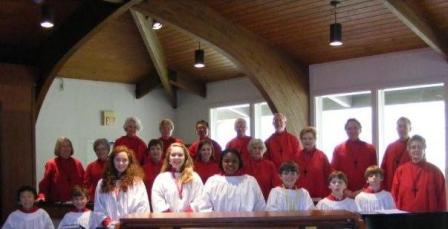 Here's the choir the next morning following the Easter service. Despite a late night celebrating the end of Lent after the Easter Vigil service in the Parish Hall (with bubbly apple cider, champagne and cake), there were a few yawns, mostly in the front row.

Here's the St. Dunstan's flute quartet.

There was an Easter egg hunt in the Beech Grove for the little children and another along the nature trail.
Here's a happy Easter girl . . .

And another wearing shades . . .

And three young ladies gathered in their lovely Easter dresses.
Monday, April 5, 2010
There’s Always One…..
For many years now, I have made it a point to get off work and attend the Good Friday services. Since I sing in the choir, it helps to add another voice to the musical offerings. The Good Friday liturgy lasts for an hour and the Stations of the Cross that follow add another two. So why would someone want to sit on a hard bench for three hours? Because the reward is so great.
The readings for the Stations of the Cross are some of the most poignant in our liturgy. The long silent pauses only serve to accentuate their power. Some of the most beautiful music has been written for the Good Friday service. I had a creative streak many years ago and wrote a few songs myself. I am certainly the least of all composers, but the best song I ever wrote is based on Good Friday readings. I have done it a time or two at our services.
Every year, there’s always one musical offering that will bring tears to my eyes. Sometimes it has been “The Reproaches”:
“Oh My people, what have I done to thee, and wherein have I wearied thee?....”
Other times it has been Helen’s heart-felt rendering of “Were You There When They Crucified My Lord?” She always says she should quit doing it, but the rest of us in the choir always encourage her to do it one more time. She sings it with such confidence and ease (and never needs any music to do it!). Other years, including this one, it has been the “Stabat Mater”, Hymn 159, which gets to me:
“At the cross her vigil keeping, stood the mournful mother weeping,
where he hung, the dying Lord. There she waited in her anguish,
seeing Christ in torment languish, in her heart the piercing sword….”
I have been fortunate never having to keep a vigil with someone who is dying, but I am reminded of the time I kept a vigil at my younger son’s bedside when he was very sick with pneumonia and was on the cusp between life and death. It is a painful place to be. I can only imagine Mary’s anguish.
So, is the service on Good Friday long? Yes, it is. It is worth the time spent? Absolutely.
Bruce Lafitte
April 2010
Saturday, April 3, 2010
What I Learned in Sunday School
Okay, it’s my last night on earth and for some reason you know it — do you accept my invitation to supper? After all, it’s not actually a conveniently timed supper and traffic is really bad, it’s backed up both ways on I-285, in fact all of the major interstates are jammed and the back roads are just as frustrating. You have this supper invitation and it’s my last night on earth, but it’s also during the week, a Thursday. You’ve been working all day and the weather is beautiful. You like me, sure, and you’ll probably miss me a little bit when I’m gone. Not to mention, you’re already going to have to take time out to dress up and show up for my funeral.
But this sit-down supper thing is a hassle, especially when you could just sit on your back porch with a glass of wine and think a few good thoughts for me. Maybe you reason that your kid will be damaged for life if you miss that Thursday night soccer practice. I don’t know it’s my last night on earth, but you do. I get a feeling it’s soon, but you are absolutely certain that I’m going to die the next day. What do you do?
Okay, so never mind me. What if the supper invitation came from someone like, say, Jesus? Would he be worth a little inconvenience? Braving a little traffic on a Thursday night? I think most of us wouldn’t give that invitation a second thought. I refer, of course, to the Maundy Thursday service.
When the disciples showed up for this last-night-on-earth supper, they had no idea, or most of them had no idea, what the next day held. Jesus may have had a pretty good idea that he couldn’t keep defying authority and get away with it. He couldn’t keep standing up against the political and religious powers in the defense of the poor and downtrodden.
I imagine that though this was his last night on earth, he had a few things penciled in on his calendar. Maybe he was going to take a much needed rest after Passover, a few days by the sea. Maybe he wasn’t tired at all and he was making plans for other protests, even bigger things that would turn the whole rotten order of things upside down. I have to think he had something planned, even if it was just a breakfast date at the Waffle House—or some equivalent.
Whatever was on his calendar, whatever he hoped to accomplish in the future, he had a pretty good idea that his days were numbered. And because he knew his time was limited, he gathered his closest and trusted friends for a meal. There were 12.
Forgive me for saying so, but there’s a fuzziness about the resurrection. We bat it back and forth in Sunday School all the time. Was it a physical body floating heaven bound? At what point did the death take on such meaning in Christianity? Who saw what? How do we know? How should we interpret it? What does it mean for us as Christians, and beyond that, how do we apply what it means in our daily lives?
But the last supper? No ambiguity whatsoever. Here’s an excerpt from Patricia’s sermon, picking up where they’re all gathered for the meal and Jesus is worried like a parent about how his children will get along once he’s no longer there to guide them:
He looks around at them with love and affection and grief, with a little frustration thrown in, too. He has tried to teach them so many things. Sometimes they seem to get it; sometimes he wonders if they have understood anything he has said or done at all.
This may be his last chance, his last lesson. How can he get their attention? How can he make them understand the core message of his life?
Suddenly he has an inspiration. He gets up from the table, ties a towel around his waist, pours water into a bowl, kneels on the floor, and begins to wash his friends’ tired and dirty feet.
Predictably, they don’t understand. Peter sputters an objection – “I’m not letting you touch my feet! You can’t do that. That’s a servant’s job.”
“Ah, that’s the point,” Jesus replies. “That’s what I’ve been trying to tell you all along. We are here to be servants; we show our love for God by loving and serving God’s people.
“I’ll be leaving you soon,” he tells them. “But my work must continue and live on in you. Follow my example. Just as I have loved you, you also should love one another. By this everyone will know that you are my disciples, if you have love for one another.”
I couldn’t count how many years I missed the Maundy Thursday service in my life. In fact, I asked my brother about it, why we’d never gone as children. “It was too radical,” he said simply. Our grandparents were put off by this unsavory idea of having their feet touched and then, of course, the intimacy of putting your hands on the feet of others.
If I hadn’t said last year that I was planning on doing the whole Holy Week thing, making every service, I might never had showed up for Maundy Thursday. As it happened, though I washed not nor was washed last year, it was the most meaningful and holy service I had ever attended. As I watched the sacred symbolic act repeated with love and humility, everything I ever learned sitting in a pew or reading or in Sunday School all came together in concentrate form, like orange juice or vanilla extract. It was this: Love one another. Serve one another.
All year, I admit, I looked forward to the Maundy Thursday service. I took off work early and got a pedicure so I could wash-and-be-washed as it were. The earthen ware pitchers and bowls were set by two chairs on either side in front of the altar. The little white towels that we used to dry each other’s feet were embroidered with small red crosses. The sermon was wonderful. We had communion. And then there was a reverent silence as the altar was stripped bare. The candles were snuffed out. The choir moved to the back of the sanctuary, soft music, beautiful “Go to dark Gethsemane” was sung.
Like last year, I came away feeling closer to God, no other way to say it. But I was surprised that more people show up for the church barbeque than for this service—I believe there were just three of us attending who were not choir, clergy, altar guild or lectors. And while I’m getting ready to practice my flute for the Easter Sunday service tomorrow, and I’m washing something to wear for Easter Vigil tonight—another beautiful service followed by cake and champagne, I’m a little disappointed.
Easter is great, no doubt. Christmas is pretty wonderful. But if I put it all into a blender, everything I learned in Sunday School, it’s that Christianity is about loving and taking care of each other.
It was Jesus' last and most important commandment before he became the Christ. Here’s the definition:
[From Middle English maunde, ceremony of washing the feet of the poor on this day, from Old French mande, from Latin (novum) mand tum, (new) commandment (from Jesus's words to the Apostles after washing their feet, John 13:34); see mandate.]
Monday, March 29, 2010
Home Stretch of Holy Season
by Sibley Fleming
This morning as we gathered in the Beech Grove with our palm leaves, it occurred to me just how close we are to the end of Lent. I guess the palms were a good clue, the triumphal procession Jesus made riding on the back of a donkey into Jerusalem to protest Roman military oppression. And now we are only a week away from the resurrection.
So how did it go so fast? It seems only yesterday that we were eating pancakes and Nancy Dillon and I were trying to decide which piece of the King cake the plastic baby was buried in on Fat Tuesday (sorry, Shrove Tuesday). The tables were decorated in green, purple and gold, a taste of Mardi Gras and Bill Hancock’s good cooking.
That was the point that historically I suppose people are supposed to start giving up foods and habits that are perhaps considered indulgent. But that’s not necessarily how it’s done at St. Dunstan’s. During Lent, we don’t give up so much as we add.
We add more books and time in study and contemplation, prayer and special services—Ash Wednesday, for instance. Many of us walked the Stations of the Cross for the first time. We searched and we questioned, walked the path in the woods up behind the church with our feet. We went in pairs and groups and alone to perhaps feel the meaning of the death and resurrection.
And while we studied and practiced, we gathered togeth er—a lot. We sat around tables and broke bread—from the supper at St. Bede’s that preceded the first Lenten lecture “God on Trial” by Joe Monti, to the supper last Friday night where Bill Hancock fed us fish fried two ways: in beer batter and Southern style in corn meal. The Japanese magnolia tree outside the parish hall blossomed. The hawks did a mating dance, which Patricia caught on film.
Then yesterday it was Saturday. I was scheduled to meet Tom Gibbs at the church to rehearse for Easter Sunday. (Tom says he likes to rehearse, which is a good thing because whenever I play anything these days on my flute, I need a lot of practice!). I walked in at 2 p.m., a young man was putting away his trumpet and Gilda was putting the final touches on a flower arrangement for the altar—long strips of palm leaves dotted with small, blood-red roses. It was perfect. “Sometimes it’s about knowing when to quit,” she said.
As Tom and I were wrapping up our practice, Gilda left a bouquet of fresh cut flowers for us to share, I think some kind of zinnias, whitish green and lovely.
Then this morning after rehearsing again with Jane and Elizabeth and Molly, after drinking a couple of cups of coffee, standing around watching Claudia and Barbara Bradshaw pulling together goodies for coffee time--some kind of blue berry crumb cake that I had a hard time keeping out of—after all of that, Maggie gathered the Passion readers into the office and gave us direction. The play and service went off with only a few hitches, the imperfections made perfect by our laughter and fellowship.
Sibley
This morning as we gathered in the Beech Grove with our palm leaves, it occurred to me just how close we are to the end of Lent. I guess the palms were a good clue, the triumphal
 procession Jesus made riding on the back of a donkey into Jerusalem to protest Roman military oppression. And now we are only a week away from the resurrection.
So how did it go so fast? It seems only yesterday that we were eating pancakes and Nancy Dillon and I were trying to decide which piece of the King cake the plastic baby was buried in on Fat Tuesday (sorry, Shrove Tuesday). The tables were decorated in green, purple and gold, a taste of Mardi Gras and Bill Hancock’s good cooking.
That was the point that historically I suppose people are supposed to start giving up foods and habits that are perhaps considered indulgent. But that’s not necessarily how it’s done at St. Dunstan’s. During Lent, we don’t give up so much as we add.
We add more books and time in study and contemplation, prayer and special services—Ash Wednesday, for
 instance. Many of us walked the Stations of the Cross for the first time. We searched and we questioned, walked the path in the woods up behind the church with our feet. We went in pairs and groups and alone to perhaps feel the meaning of the death and resurrection.
And while we studied and practiced, we gathered togeth
 er—a lot. We sat around tables and broke bread—from the supper at St. Bede’s that preceded the first Lenten lecture “God on Trial” by Joe Monti, to the supper last Friday night where Bill Hancock fed us fish fried two ways: in beer batter and Southern style in corn meal. The Japanese magnolia tree outside the parish hall blossomed. The hawks did a mating dance, which Patricia caught on film.
Then yesterday it was Saturday. I was scheduled to meet Tom Gibbs at the church to rehearse for Easter Sunday. (Tom says he likes to rehearse, which is a good thing because whenever I play anything these days on my flute, I need a lot of practice!). I walked in at 2 p.m., a young man was putting away his trumpet and Gilda was putting the final touches on a flower arrangement for the altar—long strips of palm leaves dotted with small, blood-red roses. It was perfect. “Sometimes it’s about knowing when to quit,” she said.
As Tom and I were wrapping up our practice, Gilda left a bouquet of fresh cut flowers for us to share, I think some kind of zinnias, whitish green and lovely.
Then this morning after rehearsing again with Jane and Elizabeth and Molly, after drinking a couple of cups of coffee, standing around watching Claudia and Barbara Bradshaw pulling together goodies for coffee time--some kind of blue berry crumb cake that I had a hard time keeping out of—after all of that, Maggie gathered the Passion readers into the office and gave us direction. The play and service went off with only a few hitches, the imperfections made perfect by our laughter and fellowship.
Sibley
Sunday, March 21, 2010
Walking the Stations of the Cross
By Jeanne Taylor
Today I walked the Stations of the Cross for the first time ever. Tim had spearheaded the stations for the past two years and this is his last year with us. I thought I had better get myself there before he -- and the stations -- went away. There were two other walkers besides me: Jenna, a second year seminarian; and Claudia Gimson. Tim led us in the prayers and readings.
I started out by saying that in all my years as a Roman Catholic, from birth to the day I married Josh, I had never walked or even prayed at the stations in any church I had attended. The stations were always on the walls of the sanctuaries, some sets pretty to look at, some drab and boring. I knew "something" was done before each plaque during Lent, much kneeling and dolorous murmuring, but I was never interested in even finding out what it all meant. Holy Week was an event that melted into the anticipations of Easter Sunday -- translate that into a new outfit, shoes, and the very best, a decorated straw hat!
Then today as I was walking the path (created all those years ago by Justin Bradshaw), I realized that I had participated in the station pathway for years as a member of the choir (duh). We have sung some beautiful music at the Good Friday service over the years and there is more to come in two weeks. I was already conditioned to sit and "be quiet" for three hours by my Catholic mother who said under no circumstances were my brother, sister, and I to even think about doing any kind of "fun" activity during that time. Thus, sitting in the choir loft for three hours is not a hardship.
In 1997, Josh and I went on a cruise from Istanbul to Athens, stopping in Southern Turkey, among other places. One bright and sunny day after touring the ruins of a very large temple, we were sitting at lunch talking with some shipmates about the upcoming stop in Israel, highly anticipated by us all. One lady described a pilgrimage to Jerusalem she had made years before with her church. She became tearful as she described her experience walking the Via Dolorosa. It was noisy, crowded, dirty, and hot, full of humankind mingling, buying, selling, stepping on and around each other. In the midst of it all, there was the overlay of Jesus carrying the cross, being stripped, taunted, nailed, bleeding from the crown of thorns, drinking vinegar and then dying. It sounded, to me, like nothing had changed since Jesus' time. At that time and for a long time afterward, I blew off her story, thinking that she was disappointed because the Via Dolorosa WAS so very ordinary, not at all like the pictures of beautiful gardens and "God sky" that we were shown in Sunday School.
Today I feel differently about this story. Perhaps my cruise mate really did feel the way I described, but just maybe she experienced the Via and the stations as holy among the ordinary and painful and that is why she cried. Anyway...
Walking the stations today shifted my view. God knows I am no theologian, just the missus from Peoria, but standing before each station (especially the one with the stole made by Elizabeth Mark from her mother's clothing), I started seeing the stations in another way: that even in chaos and death, there is life.
Wednesday, March 17, 2010
St. Patrick
It's both an honor and a joy to sing in the St. Dunstan's choir. The choir is a loving group which works well together. I'm thankful they let me sing with them. I'm also thankful for all the tidbits of information Tom Gibbs shares with the choir regarding the source of the music we're singing, or something about the style or the period from which it comes.
I want to share an email he sent to the choir today:
(from Tom)
Hi, everybody, on St. Patrick's Day. Someone last week asked what I was going to do for the choir on this day. Not green beer, but here is my offering for the day:
St. Patrick's Breastplate Prayer
Here we have the Breastplate, the earliest example of European poetry in the vernacular, in the well-known metrical translation by Cecil Frances Alexander (she of "All things bright and beautiful" fame). We then have a newer translation that, since it is not designed for singing, offers perhaps a version closer to the original. I first saw this translation in James Cahill's HOW THE IRISH SAVED CIVILIZATION. Cahill writes that "spells of women" should be more correctly rendered as "spells of witches," but he makes no other changes.
This web site calls the poem "lorica." A lorica is a chant, an incantation, that one sings while dressing or arming for battle. ("Be thou my vision, O Lord of my heart" is another early Irish lorica.) Legend has it that Patrick sang the Breastplate prayer as protection from the pagan Irish king Loegaire and the Druid fire-worshipers who were attempting to prevent Patrick and his followers from reaching Tara where they would proclaim the Christian faith. The power of the lorica caused Patrick and his band to appear to be a herd of deer, thus sparing them from attack. This hymn is sometimes known as "The Deer's Cry." (For more about this, and much other fascinating information, see the HYMNAL COMPANION, ed. Glover, a very scholarly and complete set of reference books published by Church Publishing.)
See you tonight!
Tom
Okay, it's Steve again. If you were at the Choral Evensong this past Sunday, I hope it was meaningful for you. If not, you missed a simple service with some very nice music. But wait, there's more. Holy Week is coming up, with several services and a lot more music. I hope to see you at some of the services (not just Easter Sunday). It will make Lent, and therefore, Easter, mean a lot more to you.
Steve Mark
(Hey, there's a Fish Fry this Friday evening at the church. I'll be there. Will you?)
Sunday, March 14, 2010
The Wax Museum That God Did Not Build
“I choose not to discuss that which I wish to forget.” That’s what my friend Lyniece Talmadge always said when someone she loved disappointed her with bad behavior. Make that very bad behavior. In taking this attitude, she never confronted the loved one, nor drew from a well of anger. These words were never spoken. The confrontation placed neatly in another room.
Basically I’m a lot like Lyniece, who is one of the best friends that I never see that I’ve ever had. I’m particularly like Lyniece when it comes to the Almighty God. Hundreds of thousands die in Haiti, but do I express any righteous indignation about God’s lack of action to prevent or minimize the suffering? No. I don’t want to go there. This would make God seriously bad and probably dissolve all of the evidence of a good God that I’ve seen firsthand.
Given that I don’t like confrontations, especially where God is concerned, in hindsight I think it is strange that I was actually looking forward to hearing Joe’s lectures this weekend: “God on Trial: The Earthquake in Haiti and the Indictment of God.” The Lenten lectures were spread over two days—Friday night at St. Bede’s with supper and Saturday morning at St. Dunstan’s with breakfast. I probably wasn’t looking forward so much to the topic as I was to sitting in Joe’s “class,” which is never anything if it is not thought-provoking.
The first night we looked at the indictments—Haiti, Katrina, Nazi concentration camps, public lynching. We reviewed His acts—Job, Abraham—the terrible behavior of a God who is basically an ego-maniacal control freak. How do you let a Guy like that off the hook? Maybe the answer is you don’t. You give up worship immediately, board up the church and go home and hide behind your door with a shotgun. This is a God to be feared, not worshiped.
Unless, of course, this is not God but a construction of men to keep us all in our places. This God, they say, is responsible for everything, our actions, the weather. This God punishes for our sins or the sins of our children or neighbors. This God sits on a throne, looking on idly as millions are slaughtered in the genocide in Rwanda.
As I thought, it occurred to me that this is probably just not an accurate interpretation of what God is at all. Man, yes. But God, no. For starters I just don’t believe that God is a control freak. If He’d wanted to keep the world and everything in it completely under His thumb—from the way the wind blows to what we crave for breakfast on a late Saturday morning—He could easily have built a wax museum.
But She didn’t. She chose to be with us if we choose to be with Her. She chose to be found if we choose to look for Her. She appears wherever there is humility and whenever we find the courage and strength to face suffering and death. There is evidence of Her in the faces of everyone we meet. She is on earth, of the earth, and She comforts us. It is nearly impossible not to see Her work. The smell of pine needles. The parishioners who build wells for clean drinking water in Haiti. The person who stops on the street to look a homeless person in the eye, and offer a smile and respect, and maybe even a dollar or two.
I’ll say one more thing—or at least I’ll lift something from the service that preceded Joe’s lecture this morning at St. Dunstan’s—a part of the reading from Philippians 2:2-11: “Do nothing from selfish ambition and conceit, but in humility regard others as better than yourselves. Let each of you look not to your own interests, but to the interests of others. Let the same mind be in you that was in Christ Jesus.”
Okay, really the last thing I’m going to say. It’s this. I think my interpretation of God, now that I’ve been forced to think about it by attending Joe’s lectures, is that She is quite easy to find. And I think that if I reflect on the words of the living Jesus, I can pretty much tell you what I think She wants from us: “Whatever you do for the least of these, you do for me.”
Love your neighbor, all of your neighbors. Do Her work, delight in Her will and walk in Her ways.
From Portland to Atlanta to Jerusalem and Beyond
By The Rev. LTC Peter E. Bauer MS USAR
Year ago, when I was about 13, I would walk out the Fifth Avenue entrance of the City Hall in Portland. My mother worked there as a senior auditor. I would visit her frequently in her office after school. I would also visit her friends Mary Conzleman, Lydia Lucker, and Hattie Yamada who would become like aunts to me. All three attended my ordination service more than 30 ago. They were all strong women who had strong opinions about everything and I cherish that they were a vital part of my life growing up.
One afternoon, I walked out of the Fifth Avenue entrance with its Italian Renaissance architecture and at the corner of Fifth And Jefferson, I stared up at the gleaming modern Georgia-Pacific building and I thought about Georgia and I thought about what it would be like to visit Atlanta.
Many years later, I had the opportunity to visit the Five Points area and the Carter Center and the King Memorial and I thought this is very OK. About a year later, I visited Atlanta for a conference and I stayed overnight at Fort McPherson, and I remember standing outside the house of then Lieutenant General Russell Honore (of Katrina fame) and thinking again that this would be a interesting place to explore.
So when I arrived in Atlanta last year to work for the Army Reserve Warrior And Family Assistance Center, I was really looking forward to being here. The words of Jane Butler were still in my ears: “Go to St. Dunstan’s, it’s a good place."
Boy, she was certainly right. I was hooked the first Sunday when I saw the beautiful grounds, the soothing interior of the church, and heard the wonderful teaching of Joe Monti, the welcoming smile and pastoral hospitality of Maggie Harvey, the warm, quirky wit of Tim Black and the absolutely wonderful sermons of Patricia Templeton. Indeed, St. Dunstan’s has been a powerful, enriching place to be for this United Church Of Christ minister and Army/ VA Social Worker.
Atlanta has been like a big Portland for me. Lots of trees, which I really appreciate, and ;iberal politics-which I also appreciate. But more importantly there has been a real sense of kindness, thoughtfulness, compassion and concern which has repeatedly touched me this past year. There has also been the art, the symphony, all of the organizations like Veterans Heart Georgia and Care for the Troops that I have been involved with and the training on Spirituality and Combat Warfare that I have facilitated at Candler School of Theology and Clayton State University that have really enriched my life.
In I Kings 19, the angel comes to Elijah twice and says “get up and eat. You need this because without it you will not be sustained for the long journey ahead
I am very thankful for the nourishment that I have sustained this year. St. Dunstan’s and Atlanta are now a part of my “sacred ground," as sacred to me as Portland or Princeton, N.J. or Bulverde, TX. I now return to the Lone Star state for my new adventure as the Chief of the Marriage And Family Therapy Program, Department Of Social Work, Carl Darnell Army Medical Center Fort Hood, TX. I will be back to practicing psychotherapy and I anticipate listening to a lot of further psychological turmoil and fall out from the terrible shootings that occurred there last November.
Lent is about pilgrimage; it is about journey. In Jesus’ case, the journey is to Jerusalem, to that sacred place, where his death will occur at the hands of the Romans. But even more profoundly, it is the new life that will emerge as a result of the Resurrection of Jesus that will transform everything.
I feel blessed that I have been transformed by you. I am counting on coming back to visit to Atlanta and St. Dunstan’s and will welcome your presence as well in Central Texas. Remember, Fort Hood is only an hour and a half from Austin.
May our journeys to our own Jerusalems (those sacred places wherever they may be) be a blessing and a source of great transformation for all of us.
Blessing and Joyous Easter and New Life To All!
Saturday, March 13, 2010
Good and Evil in Haiti
By Rev. Maggie Harney
The recent earthquakes in Haiti, Chile and Turkey have given rise, once again, to the question of God’s responsibility for these kinds of tragedies. Theologians tell us that evil can be thought of as three types—natural evil, systemic and personal evil. Earthquakes, tornadoes, hurricanes, tsunamis are all examples of natural evil. These things happen, and we human beings feel helpless before them. And there are those who, like Pat Robertson, say that God sends these natural disasters to punish sinful people.
Christians profess belief in God, the creator of heaven and earth. Science tells us that Earth came into being 4.5 billion years ago. It seems to me that the recent earthquakes have been 4.5 billion years in the making. When tectonic plates shift, volcanoes erupt, hurricanes blow in from the ocean and meteors fall from the sky, Earth is simply behaving like a planet. Earth also rolls on year after year in its course though the cosmos. We humans have nothing to do with this miracle that supports our lives. It’s beyond my ability to imagine that God has been constantly monitoring every earthquake or orbit around the sun for 4.5 billion years. (I also can’t believe that God is so spiteful that God would send an earthquake to destroy 250,000 men, women and children.)
Perhaps the evil that has brought about such suffering in Haiti is not located in the earthquake. Perhaps we need to look at personal evil and systemic evil. Systemic evil has brought about the crushing poverty that the majority of Haitians live in. Systemic evil was in the slave trade 300 years ago that brought Africans to Haiti. Systemic evil was in the French colonial system that kept Haitians at near starvation and used them like animals. When the slaves revolted and declared their independence from France in 1801, the French, English and Americans placed embargoes on the country to isolate it and that, too, was systemic evil. In 1956, the personal evil of Papa Doc Duvalier and his thugs, the Tonton Macoute, created a system of terror and suffering for ordinary Haitians. At Papa Doc’s death, his 19 year-old-son, Baby Doc, carried forward the greed and lawlessness of his father. Personal evil and systemic evil have plagued Haiti for centuries.
If you want to see the presence of God in Haiti, don’t look at the earthquake or hurricanes. The presence of God is in the hearts of the Haitians who moved rubble with their hands to save those buried beneath their own homes. God is present in the medical first responders and the U.S. soldiers who give out food, water and tents. God is present in the clergy and parishioners who dig mass graves, say prayers and mourn over the bodies of their families and friends. God is present in people world-wide who write checks and provide aid for Haiti.
God is not in the business of monitoring earthquakes and sending them to punish people. God is in the business of redeeming us when disaster strikes. God’s love bubbles up inside our hearts and moves us to compassion and action. If you are looking for God, look into the eyes of those who are loving their neighbors.
Sunday, March 7, 2010
Entering God’s Special Room
I was sitting in the church library, just settling down with a book I found on the shelves—“Abraham” by Bruce Feiler. I had just opened it when I overheard the voice of an anxious mother “Remember this is God’s special room,” she said. “And you’re going to be nice and quiet and respectful right?”
“We’re going in now?” replied a small child. I thought I heard a sense of awe, that this small person had been prepped for the moment that he or she would be entering “God’s special room.”
I don’t know who the voice of the mother belonged to but I do know she was teaching a lesson—when we go into God’s special room, we are nice and quiet and respectful.
Just as this little person was learning how to enter God’s special room, we adults had spent the previous hour in Sunday School studying the Stations of the Cross. We were doing the station where Jesus is stripped naked of his clothes by the Roman soldiers. In prayer, in contemplation, in meaning, in application to real life, it is like humiliating another human being. We went through the station where Jesus is nailed to the cross and the one where he dies on the cross.
We discussed the correct meaning of His death: a) Jesus died for our sins b) Jesus gave his life as a ransom for many—to deliver many? c) Jesus’ death is a perfect example of humility. d) Jesus died because of our sins. e) All of the above. We talked about how the cross didn’t show up as the dominant symbol of Christianity for like 450 years. We talked about the logistics, how Jesus—and others of his day—were actually nailed to a cross, how they suffered and died.
In any case, the death of Christ has lots of meanings and I suspect through just living life and study and prayer the subtler points emerge. I was thinking about this after the 10:45 service, as a group of us had gathered at the first Station of the Cross, with the intent of praying all 14. The crosses, made by different parishioners, are placed along a path through the woods behind the church, up the hill and back down again.
I’ve never walked the stations so I approached the exercise with great expectation for some sort of spiritual epiphany, emotional tug, a welling up of compassion, perhaps. But until The fourth Station—Jesus meets his mother--all I felt was a comfortable closeness as the 10 of us took turns reading, as we prayed together. As the dead leaves crunched beneath our feet, surrounded by the bare trees, as we exchanged a glance or smile and recited words and stopped before each station.

Since I had signed up to lead the group, I asked Elizabeth Wong Mark to read at this fourth station, which was made by her husband and son—Steve and Connor. The cross is draped in the fabric of the clothes that Elizabeth’s mother was wearing when she died in December. I do not remember a single word Elizabeth read but I remember vividly the very tangible relic of her mother’s death, the physical reminder of grief, of love and remembrance. Her mother was not present, yet this symbol of her death—and therefore her life—was very present.
So I’m probably wrong but I can’t help but think the only good reason to study the death of Christ, to try to connect with it on some personal level, is because to do that, requires understanding what it meant that he lived.
To get at that meaning, to understand the complexity, the nuances, I think requires questioning and immersion at some level and learning from those who are more spiritually, intellectually and theologically mature than you are (meaning me).
And of course there’s plenty of opportunity for growth. I particularly look forward to our Lenten Lecture series this coming Friday night and Saturday morning. The title is “God on Trial: The Earthquake in Haiti and the Indictment of God.” The speaker/teacher/lecturer is Joe Monti. And because it’s Joe, I know that not only will questions arise, but they will be blurted out and bump up against each other like Sunday School on steroids. And because Joe is patient and like a walking seminary, I’m pretty certain he won’t mind one bit.
Sunday, February 21, 2010
A Little Bit of Lent
Last year, I told Patricia I was going to hit all of the Holy Week services, work and other conflicts be damned. And I pretty much kept true to my word, with the exception of the Saturday evening champagne and cake and Easter Sunday morning, when I was in Alford, Fla. helping my mother move. (I did make the Methodist Easter service in Alford, however, and ended up visiting with some of my great-grandmother’s old cronies, over a big spread of country breakfast, gravy, biscuits, piles of sausages and scrambled eggs).
Last year, however, I did not make Ash Wednesday. Indeed when I got there this year at 7 o’clock, the solemn service was sparsely attended. Everyone else may have been at the noon service, but if I am any indication of how people behave, I think that a lot of people miss the best and holiest services of the year.
You can get so much accomplished within yourself by attending just one Lenten service. On Ash Wednesday, for instance, I left St. Dunstan’s feeling cleansed, forgiven, prepared to begin a season of study and contemplation. Perhaps I shouldn’t have, but I felt renewed, that everything had been put into perspective—the more I get outside of myself, I came away thinking, the closer I become to God.
That night I grabbed my prayer book and took it to bed. “Remember that you are dust, and to dust you shall return.” All of the wrong—self-indulgence, hypocrisy, envy, waste, love of stuff and dishonesty—for all of this, we asked forgiveness and received it. I lay there thinking, what a lovely feeling to feel forgiven, to be forgiven, like the glow you have when you wake up the first morning in your first house. It’s a kind of comfort, stability, warmth. Then of course you realize all of the things you have to do to keep that house—pay the mortgage, make repairs, clean, deal with sometimes whiny neighbors and taxes that are surely too high.
My new house/forgiveness feeling was immediately tested. On Thursday morning, it wasn’t 9:30 before I lost patience with a certain person I am wont to lose patience with and snapped. My boss came in, was probably irritable about something else, he snapped and instead of keeping my mouth shut, I snapped back, bigger, louder, with more bite. By the afternoon, I was picking up the phone giving some ad person what for. What for? For laying blame on someone else following an error. As a result of the call, I became the subject of a tattle-tale email with a bunch of people copied, just short of including the CEO. This is to say, I have a lot of repairs to make, many mortgages to go before I can call this new house mine. And maybe that’s one of the purposes of Lent. It is given to you and then maybe you have to work to actually deserve it.
So this morning, Sunday, Patricia referenced the line in the movie Broadcast News, about how we all know that murdering and philandering and stealing is wrong—that’s the obvious stuff--it’s the little compromises that change who we are until we no longer recognize ourselves.
The quote she gave: “What do you think the devil is going to look like? Come on, nobody is going to be taken in by a guy with a long, red, pointy tail. He will be attractive, he will be nice and helpful, he will get a job where he influences a great God-fearing nation, he will never do an evil thing, he will never deliberately hurt a single living creature. He will just bit by little bit lower our standards wherever they are important. Just a tiny little bit; just a tiny little bit.”
It was the part of the sermon that found its way to Sunday School, still vibrating in our minds as we listened to Tim talk about the first three Stations of the Cross.
So how does this apply to missing the Holy Season? I’m not sure but it feels connected. Maybe it’s like dancing around the edges of faith but then missing the most important part—because we aren’t bombarded by T.V. commercials, or ads, or big parties with eggnog and roaring fires and festive sweaters decorated with snow men and Santas. Maybe it’s because Lent is a season that begins when life is stripped bare from the earth. Like Caroline Miller wrote in Lamb in his Bosom, unlike a summer night when you are comforted by the sounds of creatures, a winter night leaves you lying there still and alone, the darkness marked only by the howling of the wind.
I’ll share one more thing—though this entry is getting long—it’s something I wrote after the Maundy Thursday service last year. It was never completely developed. I’m not sure that there was more to say, except that this year, I’m going to get a pedicure and wear shoes that I can easily slip off for the service.
I was telling my therapist that I had attended a foot-washing service during Holy Week. I told him how the service had moved me to tears. What I did not tell him was that in addition to crying, that when I reached my car in the parking lot at St. Dunstan’s, I began to sob. I could not put in words, dare not put in words the overwhelming feeling of closeness I felt to, well, God. But it was more than that. Watching my fellow parishioners quietly walk up to the altar and take turns pouring water from an earthen pot over each other’s feet, drying each other’s feet with a towel stunned, I was literally, not intellectually but literally stunned by the perfect example of humility.
I am basically a chicken. I sort of purposefully wore tights to the service so as to prevent any washing or being washed on my part. I had not had a pedicure and besides, the idea of foot-washing struck me as a strange and charismatic Baptist thing to do, something more akin to snake handling and public shows of salvation, fainting, laying on of hands, speaking in tongues.
“I didn’t actually wash anybody’s feet,” I said, lest I be accused of religious fervor. “Nor did I have my feet washed,” I told the therapist, who is Italian Catholic. The lights in his office are always soft and dim and the décor runs heavily to Buddhist gods and goddesses, glass and wood bookcases packed with volumes and volumes of psychiatric titles.
“The Christians got the foot-washing from the Jews,” he said neutrally, as he does most things.
Saturday, February 13, 2010
Hawks at St. Dunstan's


When I was called as rector of St. Dunstan’s almost six years ago, I received a note from the previous rector Margaret Rose congratulating me and telling me what a great congregation I was going to. And, she added, “You’ll have the best office in Christendom.”
She was right. Looking out my office window I have watched a line of fluffy goslings waddle behind their parents through the Beech Grove. Sitting in the rocking chair on the porch outside my office I was privileged to watch those same parents teach their offspring to take off and land from the pond.
I’ve seen a turtle slowly make its way across the parking lot. I’ve seen pileated woodpeckers, blue jays, blue birds, and cardinals. One morning Maggie and I watched in wonder as an entire flock of cedar waxwings arrived and plucked every berry over what had been a laden bush outside my office window.
There have been foxes and coyotes and even a deer. But nothing has been quite as exciting as the hawks this week.
Several people told me on Sunday that they had seen hawks in front of the church. The next morning I saw them, too. One was perched on a low, slender branch of a little tree by the parking lot. Another was on the ground. (Wikipedia says they sometimes do hunt from the ground.)
My arrival did not concern them in the least, and I stood and watched them for a long time. The next morning when I arrived they were perched on the light pole. Later that morning three of them chased each other from tree to tree, screeching at each other.
The next day I brought my camera and was rewarded. As I pulled into the parking lot I immediately saw a huge red shouldered hawk, breast puffed out in the cold, sitting in a tree. I rolled down the window, reached for the camera and started shooting.
I got out of the car and the hawk flew a few feet to another tree. Then there was a swoosh and another one flew by. I started clicking before I realized what it was I had just captured on film – the hawks were mating.
When they were finished they both sat on the branch for a while, their feathers a little ruffled and rumpled (as you can see in the photos). Then they both flew off.
Native American spirituality says the hawk is an omen of good and a messenger from the spirit world. Hawks see things others miss. Native Americans believe that hawks, with their keen eyesight and perspective from above the earth, call us to open our eyes, pay attention, and gain perspective on what is going on around us.
In the days ahead I’ll be paying attention to the hawks, trying to find their nest, and hoping to see their young in the spring.
I give thanks to God for the beauty of our surroundings at St. Dunstan’s, and for all of God’s creatures who share this bit of earth and sky with us.
Friday, February 12, 2010
The Smallest of Acts
I was in the self checkout at Kroger, scanning milk and bread, chips and yogurt, and a gallon jar of Mt. Olive whole giant dill pickles that I found on sale for about $5. Like me, everyone else within a five-mile radius of this store was stocking up in preparation for today’s snow. Lines of heavy grocery carts spilled out at each register into the aisles. Shoppers with single items, quickly darted about, weaving between the closely packed throng of bodies, queued up to pay and get home.
After a long day at the office, I had to force myself to make this trip to the grocery store. I do not like shopping under the best of circumstances and once lived on a carton of eggs for a whole week to avoid the experience. (This retail phobia doesn’t extend to book stores for some reason).
By the time I got to the checkout, I was feeling anxious. When you do your own scanning, anything can happen. The barcodes don’t work. The computer thing goes down. You have to wait for the store lady to come fix the mess, usually with some key hanging around her neck or a secret code and combination of key strokes that even a safecracker would have a hard time emulating.
Not only was I anxious, but the more items that came out of my basket, the closer the woman behind me kept inching up. Like if she allowed any space between us, she’d loose her spot. Anxious and irritated, I made a mental note to ignore this woman. She reminded me of the drivers in the morning who will break their necks—or yours—just to get a couple of cars ahead but when you get to a stop light, you’re both still in the same position you were in the first place.
It was then the gallon jar of Mt. Olive dill pickles slipped out of my hands and crashed open on the floor, creating a big green mess. I closed my eyes and shook my head, “No. This is the last thing I need.”
The woman behind me immediately offered sympathy. “It’s okay,” she said in a New York accent. “I’ll let them know there’s a cleanup. I’ll watch your things. Just go get another jar of pickles. It’s not a big deal, it happens to everyone.”
It was only then that I actually turned and looked at her face, olive-skinned, sweet smile with blindingly bright perfect teeth. I hesitated just a moment—I broke the jar after all, why should the store replace something as a result of my clumsiness? Then I just walked away, like I was on a death march, to find the shelf with the pickles, the gallon jars, the great sale. Finding them, I grabbed another jar then trudged back to my place in line, feeling sorry for myself.
My pickle mess was now covered in Ajax, a mound of blue powder and vinegar. “Thank you for watching for me. I feel terrible about this,” I told the woman, now a friendly presence, only moments ago the target of my grumpiness.
“Breaking a jar of pickles should be your biggest problem, right?” she smiled, that accent, the cadence of whatsamattayou.
“Right,” I said. And the truth is, while I do have bigger problems, her comment helped to put things in perspective. Whatever my problems, they are minor compared to the real problems that so many people face in the world—earthquakes, hunger, war, homelessness, not having a single friend. On the scale, good far outweighs bad in my life. And so oddly, that broken jar of pickles was actually a good reminder of how much I have to be thankful for—and to daily remember to thank God not only for the gift of life, but for putting strangers in my path that show the random goodness in the world through the smallest of acts.
Monday, February 1, 2010
How to Explain the Meaning of Christianity
My oldest son, Vincent, has been visiting for the last week now from Naples, Fla. Last night I mentioned to this six-foot-two, 24-year-old (who often looks the same to me as he did when he was five), how nice it would be if he came with me to church and Sunday school. If he wanted to sleep in, no problem, I said.
So when this morning came, I couldn’t have been more pleased to hear water running in the bathroom upstairs a little after 7 a.m. When I poked my head in, there was my big child, face covered in shaving cream, telling me that coffee was already brewing in the kitchen. He was getting ready for church.
On the way, in the car, we began to discuss Christianity. Vincent asked me, for instance, in this day and age, what the real meaning of Christianity was. What place should it, can it, does it have in your life? Practically speaking, why give up just about each and every Sunday, when you can sleep in, or go to the beach and sail your boat, or work on your old beat-up VW bus from high school?
Vincent was baptized by Austin Ford as a baby but he really falls under the category of the not-churched-so-much. Unlike his little brother, Wolfie, who is five years younger, Vincent was already in college when we found our church home at St. Andrews in Columbia, N.C. When Wolfie “religiously” dawned his red and white acolyte robe every Sunday and swung on the rope to ring the bell that hung in the tower of that clapboard country church.
So to answer this important question, I started with the least smart line—because you’re a natural Episcopalian, I said. Those values are the values you grew up with, that’s how we think. What I did not say was: We are liberal. We try to be tolerant. We listen to NPR, we are thinkers. We root for the underdog. We question ourselves, we try to evolve . .. I did not say those things but I think that is what I was on the verge of saying after just one cup of coffee.
“Denomination shouldn’t really matter, though, right?” Vincent said.
So I got into this weak explanation about being part of a community, about Sunday school, about spirituality and learning and studying. It made no particular impression that I could see. When I read what I said and thought as I write this, it makes no particular impression on me. Muddy, unfocused, indirect.
Anyway we arrived at St. Dunstan’s just in time to slip in ahead of Patricia, who was already in her robes, about to enter the sanctuary. Quiet, early service. Not much noise, even in the way of rustling bodies, which add up to about eight at that time of day.
Then Vincent and I were following the scripture reading “ . . . If I have the gift of prophecy and can fathom all mysteries and all knowledge, and if I have a faith that can move mountains, but have not love, I am nothing.” Vincent smiled at me and nodded his head, good stuff. It is, and it's my mother’s favorite—she read it at her house blessing.
Paul’s letter ended . . “Now we see but a poor reflection as in a mirror; then we shall see face to face. Now I know in part; then I shall know fully, even as I am fully known. And now these three remain: faith, hope and love. But the greatest of these is love.”
Though I could not explain, Why Christianity, I was fortunate in that this morning, that was exactly what Patricia did in her sermon—with Paul’s love letter. The love letter not to a romantic couple, but to a feuding congregation. Not romantic love, but Christian love, she said.
Patricia went on in her analysis of Paul:
The “more excellent way,” the way of love, acts like this, Paul says. Love refuses to stoop to petty retaliation. It shuns competitiveness and resists keeping a score card of who is right and wrong.
Love is kind and patient, even to those – maybe especially to those – who are most aggravating and annoying. Love remains hopeful, even in situations where stress and conflict seems overwhelming.
Feelings come and go, but the action of love abides.
Because Vincent heard the whole sermon, I will never have need to try again to explain what I think Christianity means. Patricia clarified even further in her sermon, and next time I will remember exactly what I want to say, should have said, knew in my heart but couldn’t pull out when I needed it:
And yet Jesus did not say that the ultimate sign of Christianity is the doctrine or creed one espouses, what church one attends, or what political positions one takes.
As important as these things might be, the ultimate sign of Christian discipleship and community is the way we treat one another.
As Jesus said to his disciples the night before he died, “By this everyone will know that you are my disciples, if you have love for one another.”
Paul reminds us today that love is the foundation of all Christian life, and without love no life can be Christian.
And since I’ve copied and pasted just about the whole sermon, which is posted on our home page, I’ll go ahead and give you the end:
It is a simple message with no high doctrinal content. That is how the world is to know us, how we are to know one another.
Amid all the complexities of our faith and life, love, kindness, and friendship are the first marks of a disciple of Christ.
Amen.
Thursday, January 21, 2010
Finding God in Haiti
By Patricia Templeton, rector of St. Dunstan’s Episcopal Church
“Then there was an earthquake, but the Lord was not in the earthquake.”
--1 Kings 19:11
This verse of scripture has been in my mind ever since the devastating earthquake hit Haiti last week.
In the story from First Kings, God tells the prophet Elijah to stand on a mountain and wait for the Lord to pass by. As Elijah waits, the mountain is buffeted by strong wind, an earthquake, and a fire. But God, the Bible says, was not in any of these natural disasters.
Then there is “a sound of sheer silence,” and in that silence God is present.
In the days following the horrific quake that shook the poorest country in our hemisphere to its core causing untold death and destruction, faithful people of all religions have asked, “Where was God in the earthquake?”
Some, like the so-called Christian broadcaster Pat Robertson, have suggested that God intentionally caused the earthquake because of Haiti’s sins.
Such talk is blasphemous, insulting to God and to all who believe in a loving creator. A God who would willfully cause such anguish and suffering would be a cruel and sadistic tyrant worthy only of contempt, not worship. That is not the God in whom I believe.
So where was God in the earthquake?
God was present in the brief, stunned, sheer silence that followed the earth’s rumbling. God was present in the cries of the wounded and dying. Their cries were God’s cries; their suffering is God’s suffering.
God was present in those who immediately went to work trying to rescue their family, friends, colleagues, and complete strangers. God was present in those who shared scarce food and water with those who have none.
God is present in the rubble and the unmarked graves of the thousands who died.
As news of the quake spread from the tiny island across the world, God was present in the relief workers from every corner of the globe who began packing their bags to go help their brothers and sisters in Haiti.
God was present in the journalists who headed for airports so that they could bring the story of Haiti’s suffering to those who can help. God was present in governments that mobilized for action.
God is present in those who reached for their credit cards, checkbooks and cell phones to send money to the relief effort. God is present in the young boy who watched the news, then went to his room and came out with $20 to send to the children in Haiti.
God is present in the prayers offered up in churches, synagogues, mosques and temples around the world. God is present with all who grieve and mourn and wait for news of those they love.
Seeing God’s presence in all of these places does not answer the question of why the earthquake happened, or why the people of Haiti have been inflicted with so much suffering for so long.
We cannot finally know why God created a world in which so much suffering exists – from natural disasters like earthquakes, hurricanes, and tsunamis, and from the human evils of war and violence, corruption, neglect and abuse.
But we do know that such evil and suffering are not what God intends for God’s people.
When humans suffer, God suffers; when our hearts break, God’s heart breaks.
God was not in the earthquake. But God has been present ever since and will continue in the weeks, and months, and years ahead to be with the people of Haiti, and urges us to be with them, too.
Sunday, January 17, 2010
Taking a Wrong Turn
It was raining and dark and I don’t drive well at night under the best circumstances. Somehow in the dark, the lights in traffic spray out and go blurry in my eyes. I know I need to get my glasses redone for night driving—but that would require bifocals and my reading prescription is just perfect as it is. So of course, when we were driving last night, despite the GPS lady that Wolfie insisted we take, I went too far on I-20 way on the other side of town. When I realized my mistake I got off the interstate so I could backtrack, I took a wrong turn around the Fulton Industrial Boulevard exit.
I have been in that area during the day. There’s an airport over there. Gas stations. Ugly industrial-looking buildings. The GPS lady told me to turn right, which made no sense to me—I was born in this city—so I turned left. “Mom, this is a bad street, this doesn’t look good. We need to get out of here,” Wolfie said nervously.
He pointed out the women standing under a street lamp, despite the rain, despite the dark, with their shirts open, exposing more than anyone would want to see—or should see. It made me feel cold just to look at them. “Mom, are they prostitutes?”
I have never actually known a prostitute and it’s probably not a good thing to judge people by appearances, but I knew instinctively that these shivery women, who were dangerously calling out to each passing car—including us—were indeed practitioners of the world’s oldest profession. “I’m pretty sure they are,” I said.
Still, I figured if I kept driving I would find my way without the GPS lady, a recognizable street, a landmark. Nothing. We were on a side street, like a cave, the further we went, the darker it became. First nervousness set in. Then fear. No longer were the people on the roadside helpless, sad women, whose life took a wrong turn who knows where, now we saw men, who wore stocking caps and floppy coats covered in big, deep pockets. They gave us reprimanding looks: “You don’t belong here.” We didn’t actually see any bad-evil-doing. It was more what we saw in their eyes, like a glaze where violence and hatred had pooled together.
Well, we found our way out, after about 10 minutes. My stupidity, of course, has made the rounds on the family phone tree. My eldest son, Vincent, has called twice this morning from Naples, Fla., to hear the details. Wolfie has chided me to no end. “I told you not to turn there!”
And this morning—although I’ve missed church AND Sunday School—my absolute favorite part of the week—we are safe. We are in our warm house in Avondale. Wolfie is lying on the sofa reading philosophy for school. And I am drinking a cup of coffee, sitting here by the window, in my fuzzy robe.
“Those prostitutes were yelling at us,” Wolfie reminded me again a minute ago, perhaps hoping that I, his mother, can make sense of what we saw. Unsaid: why isn’t anyone helping them?
“I know,” I offer weakly. “I just don’t think they’d be interested in doing the kind of work I might have for them—house work, yard work.”
I cannot get the image of those women out of my mind. Even this morning, they’re still stumbling in the dark, immodestly exposed, wet, cold, in danger. I have seen them and while I will pray and think good thoughts for them, I know they need more. And I feel helpless because I don’t know what that “more” is and I know that providing that “more” is completely beyond me.
As I contemplate the problem, I remember what I heard at the Council of the Diocese that I attended in November with Patricia and Maggie and Laura and Renee. It was in a committee that Maggie and I sat in on—to debate and approve or table a resolution to oppose and prevent sex trafficking of children in Atlanta. The room at St. Philip was packed, and as the magnitude of the problem became clear—some 200 to 300 young girls are exploited in Georgia every month--the sentiment of several people in the room shifted to the idea that the problem was so complicated, so overwhelming, so beyond comprehension, that the resolution needed study. It should be re-crafted and brought back next year for a vote, several voices said.
Maggie Harney, the priest who runs Martha & Mary’s Place at St. Dunstan’s, quickly lost patience. “We can’t afford to wait another year while these children are in harm’s way!” she told the committee, with an intensity and immovability that wasn’t up for challenge.
I was sitting by Maggie, immediately proud of her tenacity, awed by her fierce compassion for thousands of children, perhaps not even a single one of which she will ever meet. Simply put, Maggie was a pit bull in a room where there were a lot of poodles.
Eventually language was crafted that said the Bishop should appoint a committee to study the problem and find the next best steps for Diocese to help.
Now I don’t know where the Bishop is with this project at this point. But I will mention this—in the committee, we learned about the Atlanta Urban Internship Program, a ministry of the Diocese that works to oppose the commercial sexual exploitation of children in this city through education and direct intervention. For instance, the interns assist with programs at Covenant House, a shelter for runaways. There is training involved to help these girls, who have been deeply abused physically, spiritually and mentally.
I don’t know what the success rate is to help these children so that they don’t grow up to become the sad, hopeless specters that Wolfie and I happened upon last night. But I do believe that even speaking up—like Maggie did that day—can make a difference. To contemplate, to study, to remember the people that touch us when we take wrong turns--even from the relatively safety of a locked car--I think, is also important. As our Presiding Bishop is want to remind us--each human being is made in the image of God.
Sunday, January 10, 2010
Taking Faith to Work
On at least a couple of occasions when I’ve had to miss a vestry meeting or church as a result of work—the response from Patricia has been basically it’s unfortunate when work gets in the way of life.
This morning in Sunday School we were talking about not how work gets in the way of our faith but how our faith gets in the way of our work. Or maybe not how it gets in the way of work but how it manifests itself, if it carries over and what it means to take the values we discuss and practice on Sunday at church into the other six days of the week.
It can mean a lot of things. For instance, can you live a life of faith and still be able to take advantage of other people in the process of securing your livelihood? Can you feel love and compassion for the colleague who not only gets under your skin, but may even wish you ill? Can you love your enemy? And what’s more, do you have the courage to stand up to a boss or employer who directs you to hurt another person as a part of your job? Will you fire someone under false pretenses because your boss told you to? Will you write a hatchet job on someone and ruin their reputation because you were given the assignment? Do you have the courage to stand up for what is right even though your own job will be in jeopardy or certainly lost?
The other part of work and faith that we were discussing is what I call a “thing”, or what Patricia I think describes as a “calling”. It’s that thing that you’re naturally good at through no fault of your own, and it’s that thing that you enjoy. Beyond that, I guess the question is--if God gave you some gift or talent, are you able to apply it to a livelihood in which you can use it to do God’s work? Think great lawyers who defend the helpless, disenfranchised members of society. Or career waitresses who serve their customers as if they were their family members.
I personally don’t use what God gave me to do God’s work. I use what God gave me, like most people do I suspect, to put food on the table, to keep a roof over my head. It’s not that I wouldn’t or won’t someday find a way to apply my skills to more useful, meaningful work. I just haven’t yet. But maybe right now, given the economy, I should be grateful that I have work at all. And besides, in truth, I find my workplace is a great environment to practice what I got out of Patricia’s sermon last year—“the evils of the tongue”. My colleagues simply don’t know how much more difficult I would be to deal with if I didn’t at least try to take my faith with me to the office from time to time.
Subscribe to:
Posts (Atom)